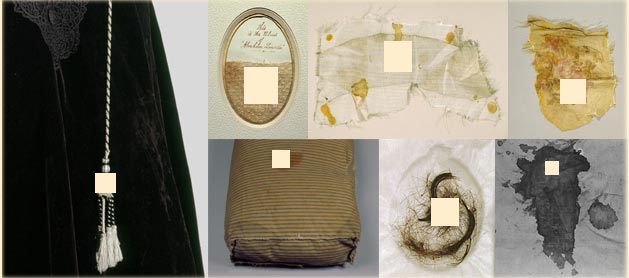
Currently available techniques for mitochondrial DNA extraction would require a square inch of bloody fabric from the Lincoln assassination artifacts or approximately five hairs.
There would be no guarantee of obtaining sufficient DNA from these aged samples. The hair would be destroyed during the extraction process and the blood on the textile samples would be completely removed. Destructive sampling of this magnitude is unacceptable for museum artifacts. It is important to leave genetic material on the assassination artifacts to await expected improvements in both sampling and testing techniques. Research collaborators hope to refine mitochondrial DNA extraction techniques for nineteenth century blood and hair specimens as part of the Lincoln investigation.
Lincoln assassination relics in the collection of the Chicago Historical Society. The empty squares represent the one-inch specimen sizes that would be required for DNA analysis using current testing methods.
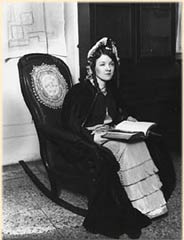
The cloak attributed to Mary Todd Lincoln has been handled by many people through the years, who may have left skin cells and DNA on the artifact. During the 1930s, a member of the Historical Society even wore the cloak for a historical reenactment. If appropriate sampling techniques are developed, researchers may have to sort through several genetic profiles on the assassination relics. However, there should be a predominant mitochondrial DNA profile in areas of heavy staining.
Chicago Historical Society member modeling the cloak attributed to Mary Todd Lincoln, c. 1930 (DN-090913).

The investigation of Mary Todd Lincoln's cloak is an ongoing project that began in June 1999.